Showing posts with label Upper Peninsula. Show all posts

Saturday, October 19, 2013

For all your "Calming" Beverages!

The rhythms and rituals of life on the Island are sacred. Now you can be reminded of your own "Island Times" while sipping your morning coffee - or the "calming" adult beverage of your choice!

Get your own "Keep Calm" mug from Cafe Press by following this link: http://www.cafepress.com/mf/83589722/keep-calm-and-island-on-drummond-island_mugs?shop=Drummond_Island

Tuesday, May 14, 2013

Once You Have Slept On An Island . . .


If once you have slept on an Island
You'll never be quite the same;   


You may look as you looked the day before
And go by the same old name,


You may bustle about in street and shop
You may sit at home and sew,
But you'll see blue water and wheeling gulls
Wherever your feet may go. 


You may chat with the neighbors of this and that
And close to your fire keep,
But you'll hear ship whistle and lighthouse bell
And tides beat through your sleep. 


Oh! you won't know why and you can't say how
Such a change upon you came,
But once you have slept on an island,
You'll never be quite the same. 


Monday, March 5, 2012

It's a Way of Life!


Do you think you could live on an Island? Do you have what it takes to be a member of a rural community accessible only by ferry, plane or boat?

Here's a bit of a test to find out if you have the right stuff . . .


Do you flash your Rolex, brag about your car, name drop about who you know, or what blue blood schools your kids attend?

Getting noticed . . . do you dream of a huge house and a garage full of cars designed to impress others? Think you are special, put on earth to be awed, sought after for advice and your presence?


Do you have an ego needing stroking? Have an attitude needing attention? Are you a gold digger? Do you want to live in a gated wealthy snobby community and is your life about money - only money?


Think you were always destined for greatness? You don't strive to keep up with the Jones - that you are the Jones.

Translation - you are NOT built for living on Drummond Island and being part of it's rural, Up North, close-knit community.


Impressing others and having the latest material items is not what living on Drummond is all about. It's about helping others, serving your community, not calling attention to yourself.

Drummond Island, simple, real, honest living.


Outdoor campfires, picnics, paddling a kayak. Snowshoeing the ledges or cross country skiing through a silent glade. 


Folks on Drummond get excited hiking a shoreline trail and seeing three deer drinking from the lake. Enjoying a sunrise on Potagannissing Bay with a mug of hot coffee. A family of loons paddling by. Island people attend and get excited to help out at a church bean supper for a family that was burned out or struggling with cancer.

It is not about who you know . . .  it's not about being exclusive. It's about others. People come for a day, stay a life time. You don't need a lot of money . . . that's not what impresses people in "Vacationland". On Drummond they help others, check on the elderly, coach youth sports. Teach Sunday school.


IT'S A WAY OF LIFE! 

Wednesday, November 23, 2011

A Thanksgiving Day Prayer . . .


 We return thanks to our mother, the earth, which sustains us.
We return thanks to the rivers and streams,which supply us with water. 


We return thanks to all herbs,
which furnish medicines for the cure of our diseases.


We return thanks to the corn,
and to her sisters, the beans and squash, which give us life. 


We return thanks to the bushes and trees, which provide us with fruit.


We return thanks to the wind,
which, moving the air, has banished diseases.


We return thanks to the moon and the stars,
which have given us their light when the sun was gone.


We return thanks to our grandfather He-no,
that he has protected his grandchildren from witches and reptiles,
and has given to us his rain.


We return thanks to the sun,
that he has looked upon the earth with a beneficent eye. 


Lastly, we return thanks to the Great Spirit,
in whom is embodied all goodness,
and who directs all things for the good of his children. 

 ~Iroquois Prayer from the 1800's

Tuesday, September 27, 2011

Delicious Autumn!


That smell.

It fills you with the tang of being up north in the fall. 
 

It is earth and decomposition and sunshine and pureness in leaf shapes.

Golden yellows, soft roasted-looking reds, flaky brown ones, orange ones speckled with bits of brightness. 
 
 
Bringing a handful to my face I close my eyes and see back to the trails I used to make in the yard as a child. Raked labyrinths leading nowhere and everywhere.

Inhaling I feel a shock of chilled air in my lungs. Exhaling I hear geese in the sky. 
 

It is one of those perfect autumnal days which occur more frequently in memory than in life.


 NOTE: DRUMMOND ISLAND FALL ON THE ISLAND FESTIVAL:

Every autumn, nature puts on a brilliant show of color on Drummond Island. From bight yellows to vibrant reds, the leaves transform the landscape,
showing off their rich and intense hues.

Every year people flock here to take in the fall foliage, 
to catch a glimpse of nature's splendor.

Now they come not only for the colors - they come for the Festival too! 
To learn more go to the official Festival website: 


Tuesday, January 4, 2011

Snowstorms are a Good Thing!

Wishing for MORE snow!


Life can be real with a snowmobile

There ain't no deal like a snowmobile


Footnote: For those of you not familiar with Stompin' Tom - he is most likely Canada's most prolific and well-known folk singer.

He was born Charles Thomas Connors (known as Tommy Messer) in Saint John, New Brunswick to the teenaged Isabel Connors and her boyfriend Thomas Sullivan. He was a cousin of New Brunswick fiddling sensation, Ned Landry. He spent a short time living with his mother in a low-security women's penitentiary before he was seized by Children's Aid Society and was later adopted by the Aylward family in Skinners Pond, Prince Edward Island.

At the age of 13 he left his adoptive family to hitchhike across Canada, a journey that consumed the next 13 years of his life as he travelled between various part-time jobs while writing songs on his guitar. At his last stop in Timmins, Ontario, which may also have been his big "break", he found himself a nickel short of a beer at the city's Maple Leaf Hotel. The bartender, Gaet Lepine, agreed to give Tom a beer if he would play a few songs. These few songs turned into a 13-month contract to play at the hotel, a weekly spot on the CKGB radio station in Timmins, eight 45-RPM recordings, and the end of the beginning for Tom Connors.

Friday, December 17, 2010

Be Safe Out There!


There probably is no such thing as “safe” ice, but there are some guidelines anglers and snowmobilers should consider. In Northern Michigan, ice conditions can vary from lake to lake, bay to bay, pond to pond and river to river. 

Before going onto a frozen lake, pond or river, it's important to take safety precautions to reduce the risk of falling through the ice. Remember you take a risk any time you go onto the ice. Anglers should always decide for themselves if it is safe to go out and walk on or drive a snowmobile on ice.

Knowing how to judge ice conditions will help you make more informed decisions while enjoying your outing. Ice thickness depends on several factors with the first and most obvious factor being location. The type of *water* also affects ice thickness; a shallow lake will freeze faster than a deep lake. Look for clear blue ice. New ice is stronger than old ice. Ice thickness is not consistent. Beware of ice around partially submerged objects such as trees, brush, embankments or structures. Ice will not form as quickly where water is shallow or where objects may absorb sunlight.

When ice fishing, it is always a good idea to drill test holes or use an ice chisel as you venture onto a lake to help judge the thickness and character of the ice. These “Test” holes should be at no more than 30 foot intervals.

You should also have a safety kit specific to ice fishing whenever you go. The items on this list will help prevent someone or something from falling through the ice. If you or someone else should fall through the ice, know how to use these tools to perform a self-rescue or assist in a rescue. The safety kit should include the following:

* Ice chisel or auger to check the ice thickness.

*Always carry ice picks or set of screw‐drivers that will float and are securely connected together with a piece nylon cord 24 to 30 inches in length. These picks should be carried allowing for quick and easy access so you can pull yourself out of the water and back onto the ice. “Pick‐of‐Life” ® is a product which is commercially available.

*50 feet of nylon rope with a large loop tied to each end.

*Wool blanket.

*Thermos of HOT liquids.

 *A cell phone or portable CB to call for assistance.

Other considerations for a safe trip include:

The use of crampons, or cleats, for walking on ice are always a good idea in Northern Michigan. With the state’s powdery snow and wind, there is often no snow cover on ice. Blowing wind and snow actually polish ice to a glassy, slippery surface.


Attaching a long cord to sleds should make them easier to pull, and if someone falls through the ice, anglers can push their sled to them while holding onto the line.

Anglers should carry two picks—or spikes protruding from wooden hand holds—that will float and are securely connected together with a piece nylon cord 24 to 30 inches in length. These picks should be carried allowing for quick and easy access in case anglers need to pull their way out if they fall through the ice.

Ice fishermen should carry a portable flotation cushion. The cushion will add to their seating comfort and give them something to throw should someone fall through ice.

Anglers should keep their augers covered because the blades are sharp, and can easily cut them, their children or their dogs.

Ice fishermen should spray vegetable oil on their auger and snowshoes. That way, snow won't stick and anglers won't cut themselves cleaning off the snow.


Beware of ice covered with snow. Snow acts much like a blanket, insulating thin ice and preventing the formation of clear, blue ice. Snow can also hide cracked, weak and open water. Daily changes in temperature cause ice to expand and contract, creating cracks and possibly pressure ridges which can affect ice strength. Extreme caution should be exercised when approaching a pressure ridge. Ice may be unstable up to 20 feet from the ridge itself.Stay away from cracks, pressure ridges, slushy or darker areas that signify thinner ice.

Traveling on a snowmobile or ATV early or late in the season is an accident waiting to happen. Do not drive across ice at night or when it is snowing. You can easily become disoriented and end up in areas of the lake you never intended to be.

Have fun! But always remember to
 *Be Safe Out There!*


For weekly updates on the ice and snow conditions surrounding Drummond Island, be sure to check out the Drummond Island MI Snow Report page on Facebook!

Monday, June 7, 2010

Buy Local First!


“We all participate in weaving the social fabric; we should therefore all participate in patching the fabric when it develops holes.” ~Anne C. Weisberg

Two or three years ago – when I started contributing “ditties” to the Drummond Island Digest – my first essay was on the ritual and routine of stocking an Up North pantry. Anyone born and raised in the north (or lucky enough to have a second home Up North) knew all to well the custom I spoke of in that article:

You walk around the house with a pad of paper and pencil, opening all the pantry doors as you jot down the essentials that need to be re-stocked. Then you call your closest friends and relatives to let them know you are “making a run” and get their lists. When the big day comes the kids all vie for “shot-gun” and you head out early in the morning for a day of shopping in the big city.

Let’s face it, retailers and warehouse super stores that can only be found in larger communities make “one-stop shopping” a concept that appeals to all of us. And when these stores can lure us in with lower prices and super sales we feel good about the money we think we are saving. But there is a hidden price . . . and one that can end up drastically altering our own small community.

In these hard economic times by thinking local first we make choices that have dramatic impact on our community, our economy, and our environment. While it will rarely be possible to buy everything we need or use from local independent businesses, I am advocating for people to first think local in order to maximize the impact of daily actions and purchasing decisions. Buy LOCAL First refers to a commitment to our community.

Compared to national competitors, local independent businesses return more money to the local economy and give an average of two to three times greater support to non-profit organizations. They are better positioned to respond to the special needs of the community and more invested in its future. When was the last time you saw Wal-Mart listed in the Digest as a sponsor for the March of Dimes Dance, the Hunter’s Dinner or the Snowmobile Grooming Fund-raiser?

Local, independently owned businesses are the backbone of an economy, the lifeblood of a community. By increasing the number of independent, local-to-local economic transactions, we:

*Support local entrepreneurs

*Sustain family farms and orchards

*Create local jobs that stay in our community

*Have greater control over environmental impacts

*Increase sales and tax receipts to finance schools, police and fire departments, arts, roads, and open spaces

*Maintain a unique sense of place, directly contributing to what will keep our home place alive and special in the long-run

*Maximize the economic multiplier (that means every expenditure of a dollar generates more than a dollar's worth of activity and cascades into a larger number of transactions that enrich the community).

Choosing local over non-local has 2-3 times more financial impact in our community, promotes more reinvestment locally, creates quality jobs, and encourages more donations to local charities and causes.

Several studies have shown that money spent at a locally owned business stays in the local economy and continues to strengthen the economic base of the community. A 2002 case study in Austin, Texas showed that for every $100 in consumer spending at a national bookstore in Austin, Texas the local economic impact was only $13. The same amount spent at locally based bookstores yielded $45, or more than three times the local economic impact. (Civic Economics, Austin Unchained October 2003)

A 2003 case study of Midcoast Maine covering several lines of goods and services validated these findings. In Maine eight locally owned businesses were surveyed. The survey found that the businesses spent 44.6 percent of their revenue within the surrounding two counties. Another 8.7 percent was spent elsewhere in the state of Maine. The four largest components of this local spending were: wages and benefits paid to local employees; goods and services purchased from other local businesses; profits that accrued to local owners and taxes paid to local and state government. All eight businesses banked locally, used local accountants, advertised in local businesses publications, purchased inventory from local manufacturers, and used local Internet service providers and repair people. The study estimated that a big box retailer returns just 14.1 percent of its revenue to the local economy, mostly in the form of payroll. The rest leaves the state, flowing to out-of-state suppliers and back to corporate headquarters. (The Economic Impact of Locally Owned Business vs. Chains: A Case Study in Midcoast Maine - New Rules Project, September 2003.)


We all support and count on doing business with people in our community, but what we don’t take the time to think about is how our community and ultimately our livelihood is affected when 85 percent of each retail dollar we spend at a national chain is sent somewhere out of state. Are we really “saving money” if our community’s retail dollars are not cycling back into our own local economy? Are we really “saving money” if our local merchants have to raise their prices in order to meet their overhead . . . or are forced to close their doors altogether due to lack of revenue? Are we really “saving money” if our local and state governments have to raise taxes or cut back on services that we wind up having to pay for?

I am getting ready to “re-stock” the pantry on Drummond and I know I can get cases of the things I need much “cheaper” down-state. But how much would I really save? Are my retail dollars ensuring that this community I have come to know and love continues to thrive? I, for one, know my quality of life would be greatly diminished if I couldn’t pop into the four corners for a bouquet of flowers, a sheet of plywood and the latest fashion magazine. And the members of this community have been truly blessed by merchants who have had the resources to donate to countless fundraisers.

We are blessed on Drummond with a variety of independent merchants of every kind. We might want to think about the greatest gift we can give both the community and ourselves . . . and the money we can “save” . . . by choosing to shop more in our own community.

“Examine each question in terms of what is ethically and aesthetically right, as well as what is economically expedient. A thing is right when it tends to preserve the integrity, stability, and beauty of the community. It is wrong when it tends otherwise.” -Aldo Leopold

Tuesday, June 1, 2010

The Hatch is on!


Think how fast a year flies by

A month flies by

A week flies by

Think how fast a day flies by

A Mayfly’s life lasts but a day

A single day

To live and die

A single day

How fast it goes

The day

The Mayfly

Both of those.


A Mayfly flies a single day

The daylight dies and darkness grows

A single day

How fast it flies

A mayfly’s life

How fast it goes.

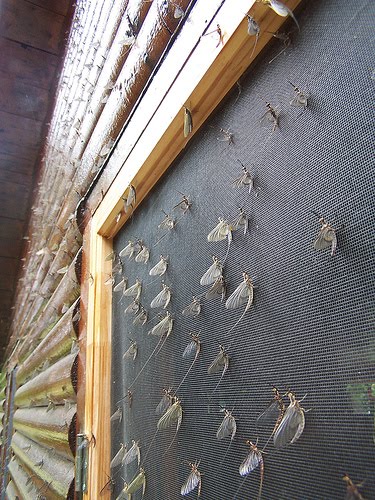
It starts like a rise of small trout. There are dimples on the surface, little fingerlings eating midges, perhaps. But these are no fish. The water breaks and up pop the wings of a Mayfly, then another and another. The hatch is on!

This legend plays out every year on calm, dark, humid nights in late May and early June. The mayflies make the television news by showing up on doppler radar or calling snowplows out of dormancy to remove layers of duns from bridges.

Mayflies have two adult stages. They first emerge from the water as duns (scientifically known as the subimago stage). They then molt into the spinner (imago) stage, in which they mate and die.

This poem is from the book The Llama Who Had No Pajama by Mary Ann Hoberman. Hoberman's poems, accompanied by Fraser's illustrations, have been delighting children for 40 years. Now, many poems from their out-of-print books are available in this fun collection. The selections are mostly humorous, sometimes contemplative, and deal with animals, family, play, and plain silliness.

Sunday, May 30, 2010

Dining in the Great Outdoors!


Although the official start of summer isn’t until June 21st, Memorial Day is considered the “unofficial” kick-off to warmer weather, longer days – and outdoor dining.

Grills will be dragged from garages. Tables and chairs hauled to the deck. Entire outdoor kitchens will be set-up and stocked. All of this so we can enjoy - after a long hard winter stuck inside - with finally being about to eat - outside!

I am in love with outdoor dining. I will brave heat, wind, rain and sometimes bugs just to eat outdoors. I have been know to Google local restaurants just to find one with "outdoor seating". Come summer - even with an entire restaurant full of empty tables, I will still ask - "Do you have anything outside?"

I will happily leave the comfort of a climate-controlled, gently lit indoor restaurant to sit in 90-degree, humid sunshine that forces me to wear sunglasses in order to see my dining companions. Doesn't matter. I am eating outside!

Wind whips my hair into my mouth as I chew - no big deal. I am eating outside! A hike down the deck and through the restaurant to get to the restroom - doesn't matter. I am eating outside! There's just something about eating outdoors that makes everything taste extra delicious.

There is something magical about eating outside that makes it worth the risk. When it doesn’t burn, the sun feels lovely; when it doesn’t gust, the wind feels playful. The night can seem more romantic outside. And eating outdoors is inherently more casual than dining inside. It’s hard to feel too formal while listening to frogs croak or watching squirrels race by.

So join me! Enjoy yourself - find someplace special to plop yourself down in a comfy chair pulled up to a table on an deck somewhere and breathe in the intoxicating air of the great outdoors!

"One cannot think well, love well, sleep well,
if one has not dined well." -Virginia Woolf

Wednesday, May 26, 2010

Digging in the Dirt . . .


To dig in one's own earth, with one's own spade, does life hold anything better? - Beverly Nichols

After a long, cold winter I am ever watchfull for the first glimpse of spring.

 How it thrills my heart to spy the first spring birds after their long vacation in Southern climes,


or the white trilliums and yellow lady slippers poking through the debris of winter,


or the new buds promising fragrant blooms on lilac bushes that dot the Island's landscape.


What I miss most, though, during the frigid, frosty months, is my connectin to the soil and what it produces, whether it's garden-fresh vegetables, sun-ripened fruits or brillant blooms.


As strange as it may sound, I need the feel of warm, black dirt running through my fingers. the outdoorsy smell of fresh-turned dirt on my work cloths and , yes, even the taste of a morsel of dirt on my tongue.

In an almost spirtual way, dirt is the substance that ties me to the earth. Just as soil keeps plants firmly anchored, it also keeps me grounded in what's real and what's important. It helps me stay connected. Working with my hands - tilling the soil, planting the seeds, watering the sprouts, hoeing the weeds, pruning the vines and harvesting the crops  yields such a rewarding sense of accomplishment.


The first day I dig my fingers deep into the soft earth I can feel its energy, and my spirits soar.